


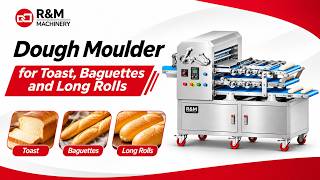


600 Continuous Dough Moulder for Toast, Baguettes and Long Rolls
Request a Quote
Enter the quantity you need and add to your quote list for pricing inquiries.
Specifications
Description
Pre-divided dough pieces enter the 600 Continuous Dough Moulder and leave as smooth, evenly rolled cylinders. Guided infeed, progressive pressing, degassing, mesh-assisted curling and staged lengthening run as one continuous forming path, so thickness, roll tightness and final shape no longer depend on repeated hand rolling.
- Dough piece weight: 20–1,000 g
- Rated capacity: 2,000–3,000 pieces/hour
- Rated power: 1.1 kW
- Standard voltage: 220 V / 380 V
It is a floor-standing machine for commercial bakeries shaping toast loaves, French-style bread, baguettes and long rolls. This page covers how the forming stages work, which doughs suit the machine, how it connects to a bread line, and what to check before ordering.
How the Continuous Dough Moulder Works
Every piece follows the same path from infeed to discharge. The stages are mechanical and repeatable, which is what reduces the variation hand shaping introduces once output rises.
1. Infeed
Pre-divided pieces are placed on the infeed conveyor. In an inline arrangement the machine can follow a compatible continuous dough divider; transfer height, direction, belt speed and the floor space between machines must be confirmed against the actual line before production.
2. Progressive Pressing and Degassing
Staged contact flattens the piece into an even sheet and presses out large gas pockets. A consistent sheet is what allows the following stages to roll the piece evenly.
3. Curling and Rolling
The sheet passes under the shaping mesh and starts to curl into a cylinder. The mesh helps guide and curl the dough during forming; it is not a guarantee of lateral containment, so confirm how it behaves on your own dough with a trial rather than assuming a fixed width.
4. Lengthening
Later forming sections keep rolling the piece out to its final length and diameter. Operators can adjust pressure and guide settings separately where they are fitted; the usable adjustment range for a given product should be confirmed on the quotation or spec sheet.
5. Discharge
Shaped pieces leave on the outfeed conveyor, ready for panning, tray loading, proofing or the next step in the line.
Forming Sections and Adjustment Points
The machine is built from a sequence of separately adjustable working sections, so a single fixed setting does not have to cover every product.
Guided Infeed
Food-contact guides help centre each piece before the pressing rollers. Consistent entry reduces sideways feeding and gives the following stages a stable starting position.
Pressure Rollers
The roller gap is set to suit the incoming dough thickness and condition. Too tight a gap can tear the sheet; too open a gap gives uneven thickness and a loose roll.
Pressure and Guide Settings
Mechanical controls let operators change forming pressure and the relationship between conveyor stages where the configuration provides them. These settings influence roll tightness, diameter and length; the range available for each product should be confirmed on the quotation or spec sheet.
Staged Conveyor Contact
Rolling is spread over several short stages instead of one abrupt pull. Staged contact reduces abrupt handling between contact points; how much the dough actually relaxes still depends on the recipe and the upstream process, including resting or proofing time.
Base and Casters
The machine stands on six braked caster wheels, so it can be rolled into position and locked before production. The lower base is fitted with lockable keyed access doors that open for maintenance and inspection; the keyed locks are the safer arrangement and help restrict unauthorised opening of the inspection doors.
Before production, lock the casters, place the machine on a level floor and confirm the unit is stable.
Capacity, Dough Conditions and Limits
The rated capacity of 2,000–3,000 pieces per hour is a nominal figure taken on a suitable product at a steady feeding rhythm. Real output is usually lower when pieces are heavy, feeding is uneven, or the machine runs inside a line whose upstream and downstream steps set the pace.
Results also depend on flour strength, hydration, dough temperature, fermentation and resting time, and on the target loaf dimensions. High-hydration or very sticky dough is not automatically suitable: test the actual dough before confirming the configuration.
Suitable Products
The machine is intended for elongated and rolled bread products within the stated weight range:
- Toast and sandwich bread
- Pullman loaves
- Baguettes and French-style loaves
- Hot dog rolls
- Sub rolls and long sandwich rolls
- Bread rolls requiring a cylindrical preform
This equipment forms the dough piece. It does not divide, proof, score or bake. Bakeries that also make pan bread often compare this model with a dedicated toast moulder RMZ-380 before choosing a configuration.
Fitting It into a Bread Line
A typical arrangement is:
Mixer → Dough Divider → Intermediate Resting/Proofing → Continuous Dough Moulder → Panning or Tray Loading → Final Proofing → Baking
The machine works as a standalone dough moulder or as the shaping section of a larger line. Upstream it can follow a dough divider and rounder and an intermediate resting stage; downstream, shaped pieces normally go to a dough proofer and then a bakery oven.
Before ordering a connected line, check the discharge height and direction of the upstream machine, the belt speed and the space available for transfer. Send the upstream equipment dimensions or a layout drawing and the transfer can be reviewed in advance. More models are listed in the bread dough moulder machine category.

Installation Dimensions and Packing
In working order the machine measures 2,625 × 920 × 1,190 mm. The export packing case measures 1,850 × 1,000 × 1,350 mm. The shorter packed length suggests the unit may ship with infeed or outfeed sections removed or retracted, so the packed footprint is a shipping dimension and should not be used for floor planning.
Final dimensions, removal points and fixing details are governed by the packing list and the operating manual supplied with the unit. Allow time for reassembly on site, and check that the conveyor sections are correctly fixed and aligned before the first run.
Machine Specifications
| Item | Specification |
|---|---|
| Product name | 600 Continuous Dough Moulder |
| Dough piece weight | 20–1,000 g |
| Rated capacity | 2,000–3,000 pieces/hour |
| Rated power | 1.1 kW |
| Standard voltage | 220 V / 380 V |
| Machine dimensions | 2,625 × 920 × 1,190 mm |
| Packing dimensions | 1,850 × 1,000 × 1,350 mm |
| Net weight | 330 kg |
| Gross weight | 410 kg |
Specifications follow the confirmed production configuration. Electrical phase and frequency must be confirmed before order approval.
Start-Up, Cleaning and Routine Checks
- Position the machine on a level floor, engage the wheel locks and confirm the unit is stable.
- With the power isolated, inspect belts, rollers, mesh, guide plates and fasteners, and remove any dough residue or foreign objects.
- Set the roller gap and forming pressure for the product while the machine is stopped.
- Release the emergency stop, switch on and observe a short no-load run for unusual noise or vibration.
- Feed pre-divided pieces evenly, without crowding the infeed or allowing hard objects into the forming section.
- Check the first shaped pieces for sheet thickness, roll tightness, seam position, diameter and length before resuming full output.
Changing Product
Changeover follows the same short sequence each time: isolate the power, adjust the guides and pressure settings for the new piece weight, clean the belts and contact surfaces, then run the first pieces and check them before production continues. Recording the proven settings for each product gives the next changeover a known starting point.
Daily Cleaning
- Isolate the power before cleaning, inspection or adjustment.
- Remove fresh dough and flour residue from rollers, belts, mesh and guide plates after each run; dried residue is harder to remove and affects the next batch.
- Check belt tracking and tension, and inspect fasteners, guides and moving parts at regular intervals.
- Do not spray electrical components directly with water.
- Stop the machine and arrange qualified service if abnormal noise, vibration or repeated product misalignment occurs.
Operation and maintenance must follow the supplied manual and the electrical and safety requirements of the installation site.
What to Send for a Quotation
The machine has to match your dough condition, piece weight, target dimensions and upstream process, not only the hourly output. Send the following and the configuration can be assessed against your line:
- Products you plan to make
- Minimum and maximum dough piece weight
- Target length and diameter after shaping
- Dough hydration or formula information
- Required hourly output
- Local voltage, phase and frequency
- Photos or dimensions of upstream and downstream equipment
- Destination country and preferred shipping terms
Request a Configuration for Your Dough
Tell us what you make, your dough weight range and your required hourly output. We will review the application and recommend the appropriate setup for a standalone dough moulder or a connected bread production line.
Get a Configuration and Quote
FAQ
What does a continuous dough moulder do?
It presses, degasses, rolls and lengthens pre-divided dough pieces into a more uniform cylindrical shape. It is commonly used before panning or final proofing for toast, baguettes, French bread and long rolls.
Does the machine divide the dough as well?
No. This model is the moulding section only, so dough must be divided before it enters the machine. It can be arranged after a compatible divider to create a continuous divider-and-moulder line.
What dough piece weights can it handle?
The stated working range is 20–1,000 g per piece. The practical result depends on the recipe and target dimensions, so the smallest and largest products should be checked during configuration.
Can it shape both toast dough and baguette dough?
Yes, the adjustable forming path is intended for toast loaves, baguettes, French-style bread and similar long-form products. Different products need different pressure and gap settings.
Can I adjust the length, diameter and tightness of the roll?
The machine provides adjustment points for the pressing and forming stages, and these influence roll tightness, diameter and length. Dough weight, hydration, resting time and elasticity also affect the finished shape, and the adjustment range available for each product should be confirmed on the quotation or spec sheet.
Is high-hydration or sticky dough suitable?
Not automatically. Suitability depends on the formula, dough temperature and surface condition, and high-hydration or very sticky dough should be tested before the configuration is confirmed. Send the formula, hydration level and a short production video for assessment.
What is the actual production capacity?
The rated output is 2,000–3,000 pieces per hour, which is a nominal figure. Actual production depends on dough weight, feeding consistency, product shape, operator workflow and whether the machine runs alone or in a connected line.
Can it connect to my existing dough divider?
It may be connected to a compatible divider, but discharge direction, transfer height, belt speed and available floor space must be checked first. Provide the divider model or a layout drawing when requesting a line proposal.
What machines can work with the 600 Continuous Dough Moulder in an automatic dough handling line?
Three configurations are commonly used. Direct moulding: a Continuous Divider followed by the 600 Moulder, which suits dough that can be shaped reliably straight after dividing and reduces the number of machines, transfers and cleaning points. Rounding before moulding: a Divider, a Rounder and the 600 Moulder, which suits dough that needs uniform pre-forming before final moulding without an extra rest; rounding does not replace proofing or resting, and it does not correct weight errors from the divider. When dough needs rest: an intermediate proofer sits between the rounder and the moulder for dough that has to relax before final shaping; the rest time, capacity and recipe output must match the line, and the intermediate rest does not replace final proofing. The final choice depends on bread type, dough weight, recipe, target output, available space and dough trials.
For a step-by-step comparison of mixers, dividers, rounders and intermediate proofers, read our bread dough line configuration guide.
Why are my dough pieces coming out at different lengths?
First check whether incoming pieces have consistent weight and resting time, then review their position at the infeed, the roller gap, forming pressure and the conveyor-stage settings. Dough temperature and elasticity also change the way each piece stretches.
What should I check if the dough tears or sticks?
Stop the machine and check the roller gap, dough temperature, hydration, surface condition and cleanliness of the contact areas. Tearing can indicate excessive compression or insufficient relaxation, while sticking usually needs a recipe, temperature or process adjustment.
What are the packing dimensions and weights?
The packing size is 1,850 × 1,000 × 1,350 mm for a machine measuring 2,625 × 920 × 1,190 mm in working order. Net weight is 330 kg and gross weight is 410 kg. The packed footprint reflects the shipping configuration, so confirm the final packing details and reassembly steps before arranging freight.


